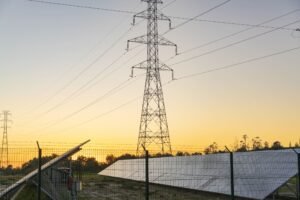
In parts of southern Portugal, large areas of land are dry and difficult to farm productively. That is leading more landowners to consider solar as a practical use of land that otherwise generates limited economic output. As renewable targets expand, this kind of land becomes more relevant — it is often easier to allocate without displacing productive agriculture, and the permitting process tends to be more straightforward.
Why Land Suitability Matters in Solar Development
Not all land is equal when it comes to solar development. Projects move faster and more predictably when three conditions align: the land is suitable in terms of irradiance and topography, the landowner is motivated to participate, and the site does not compete with high-value agricultural use.
In southern Portugal, particularly in the Algarve and Alentejo regions, these conditions frequently converge. Dry, low-productivity terrain is abundant, solar irradiance levels are among the highest in Europe at over 3,000 hours annually, and landowners with limited farming income are increasingly open to long-term solar leases or outright sale.
This dynamic is one of the structural advantages that makes Portugal attractive for early-stage solar development relative to other European markets.
The Acordo Scheme and Land Prioritisation
Portugal’s Acordo scheme — overseen by DGEG, the national energy authority — identifies and fast-tracks solar and wind projects that meet government criteria for development support. Projects on the Acordo list benefit from streamlined permitting, which compresses development timelines and reduces execution risk.
Low-productivity land sites are frequently among the strongest candidates for Acordo listing precisely because they minimise environmental conflict and agricultural displacement concerns — two of the main factors that slow permitting elsewhere.
How This Fits the Solar45 Investment Thesis
Solar45 concentrates on Portugal and builds a defined development pipeline around practical land availability. Projects are selected for their land suitability, landowner alignment, grid proximity, and Acordo eligibility — the combination that makes a pipeline more deliverable on real-world timelines.
Santa Marta, the underlying asset behind Solar45, sits adjacent to the Tavira 400kV transmission corridor in the Algarve — one of the strongest grid connection points in southern Portugal. The site benefits from exactly the kind of land characteristics described here: high irradiance, low competing use, and strong development pathway.
As renewable build-out accelerates and institutional demand for Ready-to-Build assets grows, land suitability and landowner alignment are increasingly central to what makes a solar pipeline commercially viable. Solar45 is structured around this thesis — entering at the earliest stage where these fundamentals are in place, and progressing assets toward institutional exit at Ready-to-Build.
Solar45 is the successor to the SantaMarta60 bond, which paid investors 60% over 3 years and redeemed in full in December 2025. Solar45 represents the next phase, structured to deliver a 45% fixed return at maturity over a 3-year term as set out in the offering materials.
Capital is at risk. Past performance is not indicative of future results.