The headlines blamed renewable energy; the grid data pointed somewhere far more useful.
At 12:33 on 28 April 2025, the power failed right across Spain and Portugal. Seconds were all that it took. Europe had not seen a failure this large in over twenty years. Trains stopped between stations, hospitals fell back on generators, and parts of the grid stayed dark for sixteen hours. The explanations came faster than recovery.
The earliest of them reached for one culprit: too much renewable energy on the grid. The real signal was the energy storage gap. Almost a year of investigation pointed not at how the power was generated, but at how the system failed to hold itself steady when one part slipped.
Renewable energy did not bring down the Iberian grid. The system built to keep that energy steady did.
The Story the Headlines Reached For
The reflex was understandable. Spain had been running its grid on record levels of solar and wind power, and the day of the blackout was bright and mild. When a system leaning on renewables collapses, the eye goes straight to the renewables. Heavy turbines in gas and nuclear plants resist sudden change; panels and wind farms do not, at least not in the same way. So the first story wrote itself — the green grid had been pushed past its limit. The investigators did not agree.
What Actually Caused the Iberian Blackout?
ENTSO-E, Europe’s network of grid operators, published its final report in March 2026. The report found no single cause. Instead, the blackout resulted from a series of interacting faults: uncontrolled voltage increases, insufficient reactive-power support, sequential tripping of protective systems, and the unexpected loss of stabilizing plants.
These details are significant. Conventional plants—gas, coal, and nuclear—did not provide the expected voltage support under current regulations. Additional safeguards were also insufficient. Some voltage management equipment was operated manually, protection settings were misaligned with grid requirements, and faults escalated faster than operators could respond. Damián Cortinas, chair of the ENTSO-E board, stated: “The problem is not renewable energy, but voltage control.” Voltage and reactive power determine grid stability. The failure was in the grid’s ability to maintain stability, not in the use of solar and wind.
The Energy Storage Gap the Headlines Missed
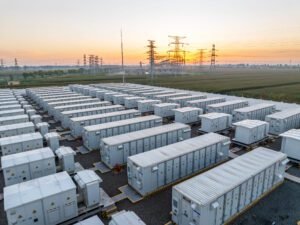
A grid that runs on solar and wind needs far more than generation: it needs ways to keep supply and demand in balance, second by second, as the weather shifts and clouds pass. That balancing layer takes in fast reserves, reactive-power support, and, increasingly, batteries. Renewable capacity has arrived fast. Systems to absorb its swings have not been built at anything like that pace.
Ember, the energy think tank, highlighted this issue before the blackout: renewable shares across the EU are rising quickly, but the flexibility to manage them has not developed at the same rate (2024). Between August 2023 and July 2024, nine EU countries saw solar meet over 80% of demand in some hours—an abundance the grid could not always accommodate. This pattern is increasingly common.
Catching up is a steep task. The International Energy Agency estimates that grid-scale battery storage must grow roughly thirty-five times this decade, towards nearly 970 gigawatts by 2030, to keep variable generation in check. BloombergNEF expects the global storage market to expand around fifteen times over the same period (2025). Those figures describe a gap, not a finished system.
And a gap is precisely what 28 April laid bare.
Why This Is a Governance Question, Not a Technology One
For investors, the key lesson is not solely about batteries. It concerns where value emerges when a system must be rebuilt under pressure, and which components generate returns. For two decades, energy investment focused on generation—maximizing megawatts at the lowest cost. The blackout shifts the focus. Reliability—delivering clean power precisely when needed—is now central to the next decade.
That shift changes what disciplined capital looks for. The value no longer resides only in the panels and turbines; it resides, more and more, in the assets that make a renewable grid behave. That means storage, balancing capacity, and the connection rights that decide whether clean power reaches demand when it is wanted. Private capital reaches these places first. Such work is slow and unglamorous, and the payoff takes years to arrive.
This is why governance comes first at Univere. A signal like 28 April does not tell an allocator what they ought to buy. What it does is more useful. It shows where the system is straining, and where the next decade of building will concentrate. Reading that early and holding the right place in the capital stack is a matter of judgement and access long before it is one of asset selection.
None of this guarantees an outcome. Infrastructure is slow and hungry for capital, exposed at every turn to policy, weather, and the price of power. The direction, though, is hard to mistake. A continent that has built renewable generation faster than the means to balance it will spend the coming years closing that distance, and storage sits near the centre of the work.
Solar45 and Baloiço both include battery storage as a core component of their investment thesis, integrated into asset design rather than added later. The broader rationale for grid resilience as a capital allocation issue is discussed in Grid Resilience Is the New National Defence.
This segment of the market is familiar to Univere. The Santa Marta Bond delivered a 20% annual return, was listed in Frankfurt, and fully redeemed in December 2025, demonstrating a completed track record in renewable infrastructure. While past performance does not predict future results, it informs how the firm interprets signals like those from 28 April.
Univere Investment Solutions designs the access architecture through which qualified capital reaches private infrastructure of exactly this kind, well upstream of any single asset. The work is selective by definition. What the coming decade will be built around did not change on 28 April. The blackout only made it harder to miss.
Professional access only. Not for public or retail audiences. Univere Investment Solutions Limited is not authorised or regulated by the Financial Conduct Authority. This content does not constitute a financial promotion, financial advice, or an invitation or inducement to engage in investment activity. Past performance is not indicative of future results. Capital is at risk.