| In brief
• Europe’s established data-centre hubs are hitting limits on land, power and regulatory flexibility. • Portugal combines a renewable share above 70%, subsea cable connectivity and a growing hyperscale pipeline, including Start Campus in Sines. • The constraint is grid congestion and renewable volatility, not demand. • Grid-scale storage such as Project Baloiço is positioned as an enabling asset for that growth. |
Europe’s digital-infrastructure landscape is undergoing a structural shift. Traditional hubs like Frankfurt, London, Amsterdam, Paris and Dublin are hitting hard limits on land, power and regulatory flexibility. At the same time, AI workloads are driving exponential electricity demand, pushing operators to search for markets that can deliver scalable, low-carbon, cost-competitive power. This is the backdrop against which Portugal has emerged as one of Europe’s most compelling destinations for hyperscale and AI-ready data-centre investment.
Portugal’s rise is powered by three structural advantages: exceptional renewable-energy penetration, globally strategic subsea-cable connectivity, and a rapidly expanding development pipeline. The country already produces more than 70% of its electricity from renewable sources, giving operators access to low-carbon baseload power at industrial prices below the European average. This renewable profile is not simply a sustainability benefit. It is now a commercial requirement for hyperscalers facing strict ESG mandates and rising carbon-pricing regimes across Europe.
Connectivity amplifies this advantage. Portugal’s Atlantic coastline hosts major subsea cable systems linking Europe with Africa and the Americas, including the 2Africa system and upcoming Google Cloud cable. This makes Portugal a natural low-latency gateway for global data flows. As a result, development activity is accelerating: projects such as AtlasEdge (9.3 MW), Merlin Properties (180 MW) and the €8.5 billion Start Campus in Sines, designed for 1.2 GW of renewable-powered capacity, are transforming the country into a future hyperscale hub.
However, Portugal’s rapid expansion also exposes a structural challenge: renewable volatility and grid congestion. Solar and wind generation create midday surpluses and evening deficits, while high-voltage grid upgrades lag behind the speed of data-centre construction. This mismatch between renewable generation and digital-infrastructure demand is the single most important bottleneck in Portugal’s growth story.
This is precisely where Project Baloiço becomes strategically relevant for investors.
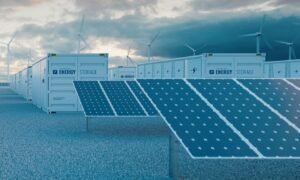
Baloiço is a 30 MW / 120 MWh grid-scale battery energy storage system designed to absorb excess renewable generation during low-demand periods and discharge during peak evening loads. In practical terms, Baloiço provides the flexibility and stability required to connect large-scale data-centre campuses, such as Start Campus, without overloading the grid. It reduces curtailment, increases renewable utilisation, and supports the integration of hybrid energy systems combining solar, wind and storage.
For investors, Baloiço represents a critical enabling asset. It sits at the intersection of Portugal’s two fastest-growing infrastructure themes: renewable-energy expansion and hyperscale data-centre development. As Europe requires between €240 billion and €289 billion in new data-centre infrastructure by 2030, Portugal is positioned to capture a meaningful share of this capital, provided the grid can support the load. Storage assets like Baloiço are therefore not ancillary; they are foundational to the country’s ability to scale.
Baloiço also differentiates Portugal’s model from fossil-fuel-dependent approaches seen elsewhere. In the United States, for example, a developer attempted to build a 3,500 MW natural-gas-powered mega-campus in Virginia, an approach ultimately rejected due to environmental and community concerns. Portugal’s strategy is fundamentally different: it prioritises high-value, renewable-powered digital infrastructure supported by flexible storage, not fossil-fuel generation.
In summary, Portugal offers investors a rare combination of renewable abundance, global connectivity, competitive power prices and scalable land availability. But the country’s ability to convert these advantages into long-term digital-infrastructure growth depends on grid-scale storage. Project Baloico is positioned as one of the enabling assets that make Portugal’s data-centre revolution possible. It strengthens grid resilience, unlocks renewable-powered hyperscale development, and aligns with national policy priorities for sustainable, productive digital growth.
For investors seeking exposure to Europe’s next major digital-infrastructure hub, Baloiço represents a strategic entry point into the backbone of Portugal’s emerging AI economy.
UNIVERE INVESTMENT SOLUTIONS | Access. Without the Noise.
Professional access only. Not for public or retail audiences. Univere Investment Solutions Limited is not authorised or regulated by the Financial Conduct Authority, and communicates this content in reliance on the relevant financial promotion exemptions under FSMA 2000. This content does not constitute financial advice or a personal recommendation. Capital is at risk. Investments may be illiquid and difficult to realise. Past performance is not indicative of future results. Prospective investors should seek independent financial and legal advice before making any investment decision.