For the first time, Europe assigns a price to the carbon content of its imports at the border. This shift affects not only emissions but also economic decisions.
On 1 January 2026, the EU’s Carbon Border Adjustment Mechanism (CBAM) entered its final phase. After over two years of transitional reporting, carbon emissions from several imported goods now incur a financial cost. This marks the point where the policy shifted from reporting to directly influencing costs, competitiveness, and capital allocation.
CBAM does something the carbon debate has lacked for decades: it puts a price on imported emissions at the European border.
What CBAM Actually Does
It was established by Regulation (EU) 2023/956, the CBAM is designed to battle “carbon leakage”, which is the risk that EU climate rules simply push carbon-intensive production overseas. According to the European Commission, it is guaranteeing that the carbon price of imports is equivalent to the carbon price of domestic production, so that EU climate objectives are not undermined by cheaper, higher-carbon imports.
The CBAM currently covers six carbon-intensive sectors: cement, iron and steel, aluminium, fertilizers, electricity, and hydrogen. Importers that exceed a 50-tonne annual threshold must become authorised CBAM declarants, with applications due by 31 March 2026. CBAM certificate sales start in February 2027, with the first certificate surrender later that year. Full implementation will phase in through 2034, and the scope may expand to additional downstream goods from 2028.
Why EU Carbon Border Adjustment Investment Matters Now
CBAM turns carbon from an external issue into a direct cost for businesses. According to CarbonChain, CBAM cost exposure is tied to EU emissions trading prices, which increased sharply in 2025 and are expected to rise further. Companies using default emissions values instead of verified supplier data risk higher costs as financial liability takes effect.
This changes competitive dynamics. EU producers using clean energy gain an advantage over higher-carbon imports now subject to border costs. Energy-intensive industries with verified low-carbon supply chains become more competitive. For investors, this represents a structural shift in asset and business model value.
The Connection to Clean Energy and Real Assets
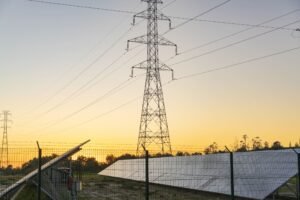
CBAM strengthens the investment case for domestic, low-carbon production and for the clean energy infrastructure that supplies it. A manufacturer powered by cheap renewable electricity inside the EU is now structurally advantaged against a higher-carbon competitor importing into the bloc. This strengthens the value of renewable generation capacity, the thesis behind assets like Solar45, and connects directly to the wider European energy transition explored in Europe’s €584 billion grid question.
This approach aligns with the strategic autonomy goals of the EU Critical Raw Materials Act. Both policies show Europe’s commitment to using regulation to favor domestic, lower-carbon, and strategically secure production over cheaper, higher-risk imports. For investors, this regulatory direction provides a lasting signal to consider in valuations.
What Investors Should Weigh
CBAM brings complexity and some controversy. It creates administrative burdens for importers, raises questions about commercial relationships and WTO compatibility, and its full impact will emerge as certificate obligations begin in 2027 and the scope expands. While significant, the mechanism is still phasing in, and its exact effects on specific industries are not yet clear.
What is clear is the direction. Carbon pricing at the border is now a permanent feature of the European economic field, and it tilts the competitive field toward low-carbon, domestically produced goods and the clean energy that powers them. For investors with a multi-year horizon, that tilt is a structural input to where durable value will accumulate — the kind of policy-aligned positioning explored in what Univere looks for before bringing an opportunity forward.
The EU has spent years seeking a fair approach to carbon pricing that does not export emissions. CBAM is the chosen solution and is now in effect. For investors who view policy as a leading indicator, CBAM signals a shift toward clean energy and low-carbon real assets. Univere Investment Solutions operates where policy direction, asset quality, and access converge.
Professional access only. Not for public or retail audiences. Univere Investment Solutions Limited is not authorised or regulated by the Financial Conduct Authority. This content does not constitute a financial promotion, financial advice, or an invitation or inducement to engage in investment activity. Past performance is not indicative of future results. Capital is at risk.