
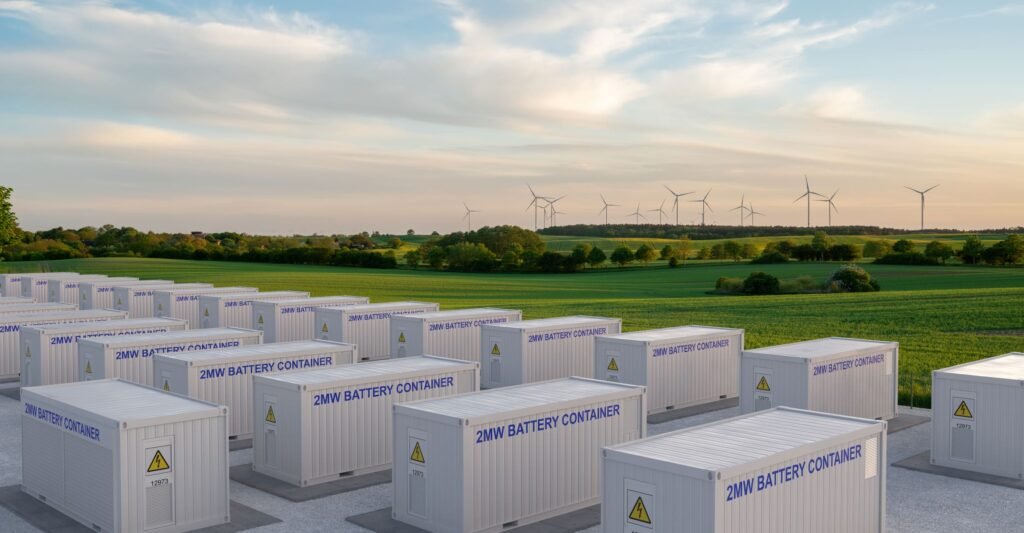
On paper, a grid-scale battery is a single asset, a row of containers, a transformer, a grid connection. It earns like four. The battery storage revenue stack is the reason one site can be paid to sit ready, paid again to trade electricity across the day, and paid a third and fourth time for services most people never see. Grid-scale storage is among the faster-growing assets in the energy transition (Rabobank, 2025). That growth rests on something easy to miss: a market design that lets one asset sell several different things at the same time.
A battery’s return is set by how it is governed across markets, not by its cells.
The Battery Storage Revenue Stack Explained:
Stream One — Trading the Daily Price Spread
Electricity prices fluctuate throughout the day. Batteries purchase power when it is inexpensive and abundant, then sell when demand and prices rise. As more wind and solar are integrated, midday prices decrease while evening peaks remain high, widening the spread. Analysts expect this arbitrage to represent a growing portion of battery storage revenue (Rabobank, 2025). Effective timing is essential.
Stream Two — Keeping the Grid at 50Hz
The grid runs at 50 hertz. It has to. When supply and demand drift apart the frequency moves, and if it moves too far, equipment trips and the system edges towards blackout. Batteries are unusually good at correcting this, because they react in well under a second. Britain’s system operator, NESO, buys that correction through a suite of dynamic response products: Dynamic Containment, Dynamic Moderation, and Dynamic Regulation. From January 2026, NESO began dispatching these services directly through its Open Balancing Platform (Modo Energy, January 2026). This used to be where the money was. It is less so now: as battery capacity grew, the early premium on frequency services compressed sharply (BloombergNEF, 2024).
The April 2025 Iberian blackout highlighted exactly why frequency response matters, covered in depth in what the Iberian blackout revealed about the energy storage gap.
Stream Three — Answering the Operator’s Call
In addition to frequency management, NESO must balance total supply and demand on a minute-by-minute basis. The Balancing Mechanism is used for this purpose, and batteries are well-suited to participate. Ongoing reforms are expanding battery access to this market, which, along with wholesale trading, has become a significant contributor to battery storage revenue.
Stream Four — Getting Paid to Be Available
The first three streams pay a battery for doing something. The fourth pays it for being there. Through the Capacity Market, the system buys insurance against tight winter evenings, holding auctions four years ahead and one year ahead, paying successful assets a fixed sum to stand ready when demand peaks. The payment is modest next to trading income. Its value is that it is contracted and predictable, a floor beneath more variable battery storage earnings (Modo Energy, 2026).
What Stops a Battery Earning All Four at Once?
Mostly, physics and time. A battery has finite energy and can only do one thing with a given megawatt-hour. Energy promised to frequency response cannot also be sold into the evening peak. The battery storage revenue streams compete.
Revenue stacking is a matter of allocation, not simple addition. Operators must evaluate four markets simultaneously and determine, for each half-hour, where each megawatt-hour will generate the highest return, while honouring existing commitments and managing battery degradation. Effective allocation maximises returns, while poor decisions can reduce overall earnings.
The Governance Point Hiding in the Wiring
This is where the battery stops being a story about batteries. The hardware is a commodity. What is not a commodity is the right to access those four markets, the systems to trade them well, and the governance that decides when to chase a spread and when to honour a commitment. Why storage earns more precisely when the grid grows more volatile is set out in from barrel risk to megawatt certainty.
The projects Univere introduces, Baloico and Solar45, both reflect this operational discipline, where governance provides the competitive advantage rather than the hardware.
Univere Investment Solutions introduces and distributes access to private market opportunities where that discipline is the point. In the renewable space, investors introduced through Univere have accessed structures including a Frankfurt-listed bond, created and structured by a trusted third party, that paid investors 20% per annum and redeemed in full in December 2025. It is cited as a completed result, nothing more.
The energy transition is being financed one asset at a time, and capital tends to follow the assets that earn. Whether they earn depends, as it always has, on the governance built around them.
Professional access only. Not for public or retail audiences. Univere Investment Solutions Limited is not authorised or regulated by the Financial Conduct Authority. This content does not constitute a financial promotion, financial advice, or an invitation or inducement to engage in investment activity. Past performance is not indicative of future results. Capital is at risk.