
Four developments in a single week. Read separately, they are four news items. Read together, they are one direction of travel — and it points squarely at where disciplined capital should be looking.
Some of the most consequential shifts in markets do not announce themselves with a single dramatic headline. They arrive as a cluster of seemingly separate stories that, viewed together, describe a structural change already underway. The week of 8 June 2026 was one of those moments for European energy investment in 2026. The European Union launched a €25 billion scheme to build renewables across the Mediterranean. Fresh analysis put hard numbers on the scale of the continent’s grid challenge. And Portugal quietly confirmed its place at the centre of Europe’s energy and digital future.
None of these stories made the front page of the general financial press. All of them matter. Here is what happened, and what it means for capital positioned over a multi-year horizon.
The EU Just Committed €25 Billion to Mediterranean Renewables
On 11 June, the European Commission launched the Trans-Mediterranean Renewable Energy and Clean Tech Cooperation, or T-MED — a flagship initiative under the wider Pact for the Mediterranean. As reported by PV Tech, the platform aims to mobilise €25 billion in investment by 2035 and contribute to the development of 15 GW of renewable energy capacity across North Africa and the eastern Mediterranean.
The mechanism is as important as the headline figure. According to the European Commission’s own announcement, the Commission has made €5 billion available in guarantee capacity, explicitly designed to unlock public and private investment across the sectors T-MED covers. This is not a grant programme. It is a structure built to bring private capital alongside public money into renewables, hydrogen, clean technology manufacturing, and modern electricity networks.
The strategic logic was stated plainly by the EU. As Dubravka Šuica, Commissioner for the Mediterranean, put it, the region holds vast untapped renewable potential — around 2,300 GW, more than twice the EU’s current capacity — with solar and wind costs 30 to 40% lower than in Europe. Energy Commissioner Dan Jørgensen framed the rationale in terms that will be familiar to anyone who has followed Univere’s analysis: energy security can no longer rely on diversifying fossil fuel imports, and the answer is electrified systems built on clean energy, strong interconnections, and efficient networks.
This is the same argument we set out in detail in what the Hormuz closure reveals about energy infrastructure. Imported energy carries a route risk that no contract can fully price. Domestic and near-shore generation does not. The T-MED scheme is the EU acting on exactly that principle at a scale of tens of billions.
The Real Bottleneck Is Not Generation. It Is the Grid.
If the Mediterranean scheme is the EU adding generation, the second story of the week is a reminder of the harder problem: moving that power once it exists. A detailed analysis published on 10 June by Energy Industry Review laid out the scale of Europe’s grid challenge in numbers that are difficult to overstate.
The European Union needs to integrate around 100 GW of renewable energy every year, connect hundreds of gigawatts of storage, and support the accelerated electrification of the economy. Standing in the way is grid infrastructure. The analysis put total investment needs at more than €1.2 trillion by 2040 — with the EU’s own grids package identifying €472 billion needed for transmission and a further €730 billion for distribution networks over the same period. Annual EU grid investment needs to rise from roughly €70 billion today to between €81 billion and €124 billion.
The constraint is already biting. The European Commission estimates that up to 1.7 terawatts of renewable energy projects are waiting to be connected to the grid — enough, if connected, to multiply the EU’s wind and solar capacity by 2.6 times. In some member states the situation is acute: Austria, Bulgaria, and Romania reported zero capacity for new generation on parts of their transmission network, and Finland has an estimated 400 GW of renewables queuing for connection.
This is the precise thesis we have argued across several pieces. The value in the energy transition is migrating from generation toward the infrastructure that makes a renewable grid work — transmission, storage, and connection rights. We set it out in full in Europe’s €584 billion grid question and, on the resilience side, in what the Iberian blackout revealed about the energy storage gap. The June analysis adds fresh weight to the same conclusion: generation is increasingly solved, and the grid is where the next decade of building — and value — will concentrate.
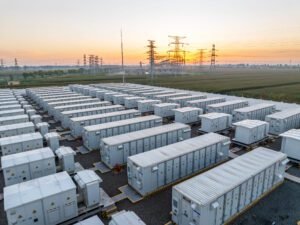
One detail in the analysis is worth singling out for investors focused on the Iberian market. Among the practical solutions European countries are adopting, the report notes that Portugal, Poland, and Bulgaria have facilitated grid connection by hybridising existing renewable projects with battery storage. That is not a footnote. It is the integrated solar-plus-storage model in action — the exact structure behind assets like Solar45 and Baloiço, where storage is built into the asset rather than bolted on afterwards.
Why Portugal Is the Country to Watch
The third strand of the week’s news brings the picture home to the market Univere knows best. Writing in The Portugal News on 10 June, Paulo Lopes made an observation that deserves far more attention than it received: the arrival of thousands of Nvidia processors destined for the Start Campus data centre at Sines had a measurable impact on national investment figures and Portuguese economic growth. When the import of technology moves a country’s economic indicators, something larger than a single business deal is underway.
The significance lies in why Sines was chosen. As the piece notes, it combines characteristics few places in Europe can offer at once: access to renewable energy, room to grow, international connectivity through submarine cables, and a strategic geographic position. International companies are installing some of the largest technology investments on the continent there — and they are doing so because of the clean, abundant power Portugal can provide.
This closes the loop on the week’s other two stories. The grid analysis explains why moving clean power is hard. The Mediterranean scheme explains where new generation will come from. And Sines explains the demand side — why all of this clean power suddenly has a buyer. Artificial intelligence and the data centres that run it are enormous, sustained consumers of electricity, and they cluster where clean power is cheap and reliable. Portugal, generating more than 80% of its electricity from renewables in peak months, is exactly such a place. We examined that position in detail in Portugal’s 80.7% renewable milestone.
The connection between cheap renewable power and the industries that cluster around it is the same dynamic we explored in the case for green hydrogen in Portugal. Whether the offtake is hydrogen production or AI compute, the underlying logic is identical: surplus clean generation attracts the industries that need it, and those industries deepen the value of the generation and storage assets that supply them.
Four Stories, One Direction of Travel
Step back from the individual headlines and the shape of the week is clear. Europe is rebuilding its energy system around three pillars at once: new clean generation, both domestic and near-shore through schemes like T-MED; the grid and storage infrastructure required to move and balance that power; and the high-value industries — AI, data, hydrogen — that run on cheap clean electricity and anchor demand for decades. Portugal sits at the intersection of all three.
For capital, the lesson is not to chase any single headline. It is to recognise the structural direction these developments collectively confirm. A €25 billion Mediterranean scheme, a €1.2 trillion grid challenge, and a data centre boom built on renewable power are not three separate stories. They are three views of the same transition — and that transition is precisely the area Univere has been positioned around.
None of this removes the discipline that sound investment requires. Infrastructure is slow, capital-intensive, and exposed to policy, permitting, and execution risk. A scheme announced is not a project delivered, and a grid investment target is not the same as a grid built. The opportunity is real, but it is governed — by the quality of the individual asset, its position in the capital stack, and the team executing it. That is the discipline we set out in what Univere looks for before bringing an opportunity forward.
Univere Investment Solutions designs the access architecture through which qualified capital reaches private infrastructure of exactly this kind, well upstream of any single asset. The events of this week did not change that work. They only made the case for it harder to miss.
Professional access only. Not for public or retail audiences. Univere Investment Solutions Limited is not authorised or regulated by the Financial Conduct Authority. This content does not constitute a financial promotion, financial advice, or an invitation or inducement to engage in investment activity. Past performance is not indicative of future results. Capital is at risk.