The assets that keep the lights on are being treated less like renewables and more like water and telecoms, and capital is following the reclassification.
On 28 April 2025 at 12:33 p.m., Spain and Portugal experienced a major blackout. Around 15 GW of supply was lost within seconds, leaving more than fifty million people without power for most of the day. Train services halted and cash machines failed within minutes. The event reminded Europe that electricity supply is not guaranteed; the grid is a complex system that can fail. Battery storage was a central focus in the analysis that followed.
When an asset becomes critical to a functioning society, capital starts to treat it differently. Grid-resilience battery storage investment has just crossed that line.
From Clean Energy to Critical Infrastructure
For most of the past decade, batteries were sold as a partner to solar and wind. That framing is now too small. The grids of advanced economies are being asked to absorb record volumes of variable generation, and the physics of keeping them stable has become a public-interest problem rather than a private-sector preference.
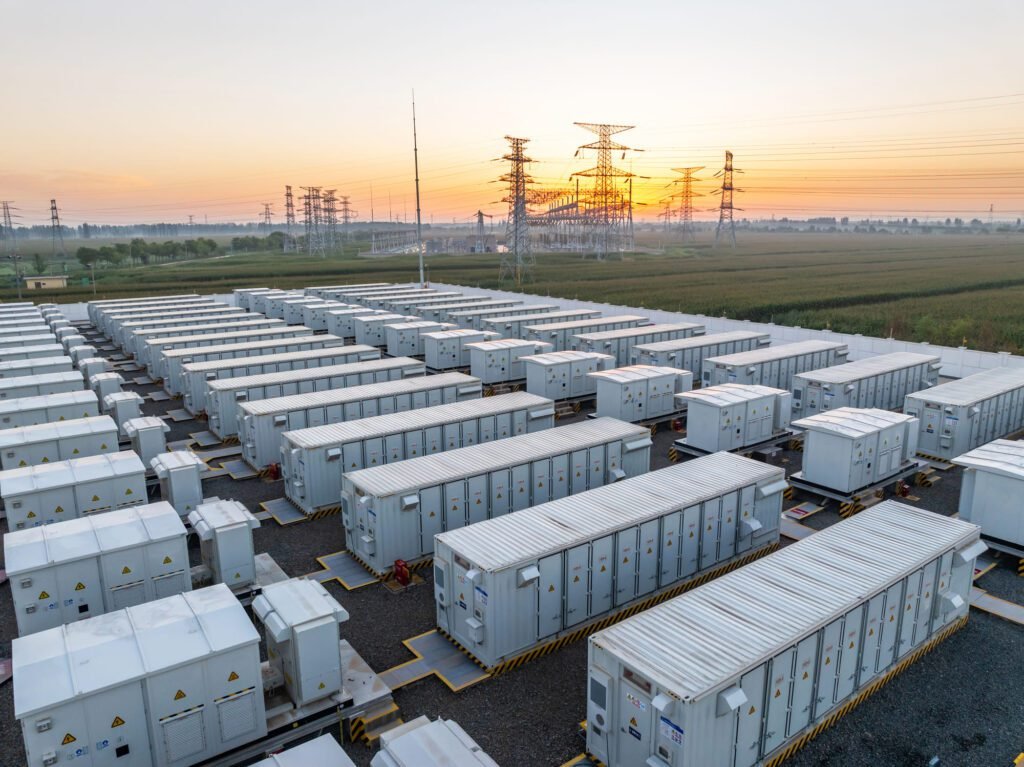
The IEA’s Global Energy Review 2026 reported that global battery storage capacity increased by 40% year-on-year to 108 GW in 2025, making it the fastest-growing energy technology that year. Capacity is now around eleven times higher than in 2021. This is a shift from battery storage as an optional add-on to essential infrastructure. The mechanics of how it earns across four separate income streams are explained in the battery storage revenue stack.
Why Is Electric Grid Resilience Battery Storage Treated as Critical Infrastructure?
Because the grid cannot function without it. Battery systems respond in milliseconds to balance supply and demand, hold frequency steady, and help restart networks after a fault. As coal and gas plants retire, that stabilising role passes to storage, moving it from a commercial option to a public necessity, much like water or telecoms.
When a solar plant in southwest Spain reduced output last April, the system lacked sufficient fast-acting reserves to compensate, highlighting exactly the gap that increased storage is meant to address. BloombergNEF analysts have noted that Spanish grid investment lagged the European average, while Portugal responded by committing to a major grid-resilience package and scaling battery capacity toward 750 MW. What the blackout revealed about that gap is set out in what the Iberian blackout revealed about the energy storage gap, and Portugal’s broader stability in Portugal quietly became Europe’s most stable energy market.
The Capital Is Broadening
Investors in grid-resilience battery storage now extend beyond renewable-energy specialists. Pension schemes, insurers, and multi-asset managers, institutions that own toll roads, airports, and water utilities, are increasingly classifying storage as core infrastructure instead of alternative energy.
PwC projects annual energy-storage investment will reach approximately 91 billion US dollars in 2025, about 3.7 times the previous year (PwC, 2026). This reclassification is significant. Once an asset is labelled as infrastructure, it attracts long-term capital that values predictable cash flow over rapid growth.
Resilience Is a Governance Question First
Storage is not without risk. All infrastructure investment carries capital risk. Returns from fast-frequency services have already declined in mature markets as supply has increased. The opportunity is real but depends on governance. The difference between a strong and a weak position is often determined by how access is structured, how risk is allocated, and the quality of the asset’s supporting framework.
This is the layer Univere Investment Solutions works in. Univere introduces and distributes the access and distribution architecture through which qualified investors and their advisers reach products of this kind, created and structured by trusted third parties, with suitability and governance settled first. Structure precedes opportunity.
What It Means for How Capital Is Placed
Investors introduced through Univere have accessed structures including the Santa Marta Bond, a Frankfurt-listed instrument that paid investors 20% per annum, completed its three-year term, and was redeemed in full in December 2025, returning capital plus 60% over the period. It was a defined, finite result: the structure did what it was designed to do, and then it closed. That approach continues through the projects Univere introduces, including Solar45 and Baloico.
Univere works with regulated intermediaries, family offices, and qualified investors who think about access and governance before they think about any single asset.
Professional access only. Not for public or retail audiences. Univere Investment Solutions Limited is not authorised or regulated by the Financial Conduct Authority. This content does not constitute a financial promotion, financial advice, or an invitation or inducement to engage in investment activity. Past performance is not indicative of future results. Capital is at risk.