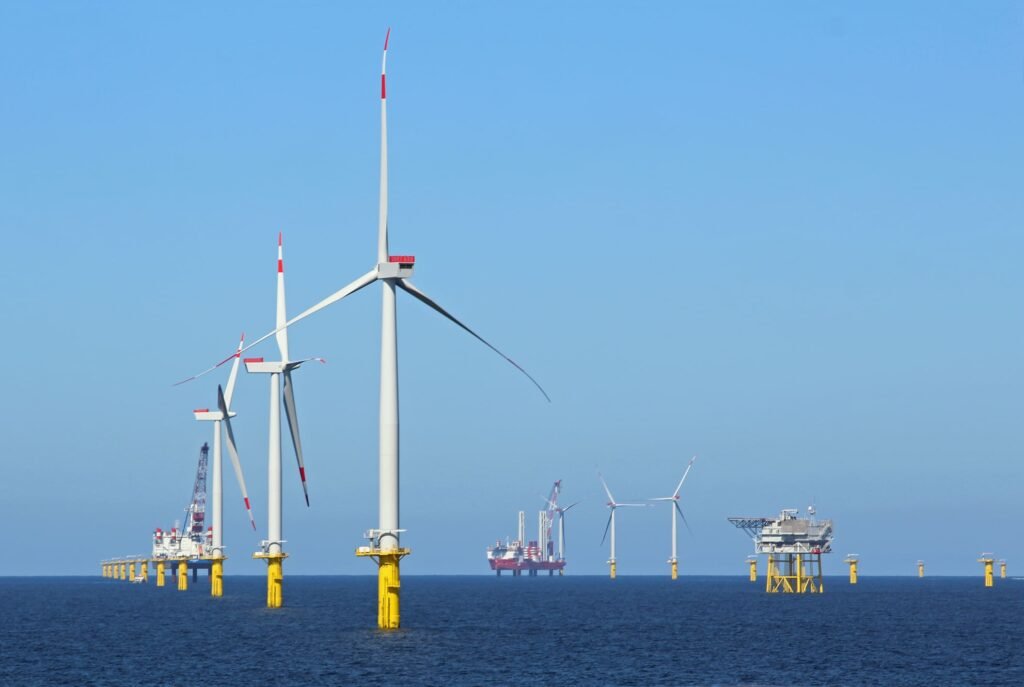
Over recent years, the world’s largest publicly listed oil and gas companies have committed tens of billions to renewables, electric mobility, and low-carbon infrastructure (Wood Mackenzie, Corporate Energy Transition Outlook, 2024). The pattern is sector-wide. In 2021, TotalEnergies rebranded from Total to signal that diversification had moved from a peripheral project to a defining position. BP owns Lightsource, one of Europe’s largest solar developers. Shell operates one of Europe’s largest EV charging networks by station count. Equinor is a global leader in offshore wind. Each of these firms is doing the same thing: running a portfolio diversification strategy on the corporate balance sheet.
This shift is not ideological, and it is not linear. Several firms have reversed or softened early decarbonisation targets when oil prices recovered. BP raised its upstream oil and gas investment and cut clean energy spending in 2025; Equinor announced it would roughly halve its renewables investment over the following years. Yet meaningful renewables exposure remains on each balance sheet. It is that simultaneous commitment, hedging into the transition while defending the core, that makes the behaviour worth reading.
The Hedge Inside the Balance Sheet
Oil majors are not building solar farms because they have changed their view of the world. They are building them because their existing exposure is concentrated against a known set of long-term risks: policy shift, demand decay, and a rising cost of capital for hydrocarbons. Allocating into the energy transition is a portfolio response to a portfolio problem.
This is genuine hedging, real capital committed against unavoidable exposures, not language in a sustainability report. According to the IEA’s World Energy Investment 2024 report, global clean energy investment now runs at roughly twice the level of fossil fuel investment, a crossover that has held and widened since 2023. Incumbent corporate capital has been part of that shift.
What a Portfolio Diversification Strategy Actually Means
The instinct in private portfolios is to treat diversification as a question of count. More assets. More managers. More geographies. The behaviour of the oil majors suggests something different. Diversification is not about owning more things. It is about owning things that respond differently to the same shock.
A portfolio with equities, bonds, property, and gold is generally considered diversified, while one with public equity across five global indices is seen as concentrated. The same principle applies to private allocations: holding multiple vehicles that all benefit from similar conditions, such as falling rates or rising demand, does not constitute true diversification. It is simply the same exposure in different forms.
This is the same argument explored from a private investor’s perspective in the portfolio logic of uncorrelated real assets, and from the market-structure side in reinventing diversification.
This is the same argument explored from a private investor’s perspective in Investment Diversification Strategy: Beyond Traditional Asset Allocation.
What Do Oil Majors’ Renewables Bets Tell Private Investors?
The lesson is about portfolio behaviour, not about energy. When the firms with the most exposure to hydrocarbon risk commit billions to a parallel sector, they are hedging, not converting. The implicit signal is that any diversified portfolio should ask whether it carries comparable exposure to the same theme.
This is not advice. It is an observation. The largest hydrocarbon firms in the world have answered the question with their own capital. Their reasoning is published quarterly. Their conviction is measurable in dollars deployed. The behaviour of one firm can be dismissed. The behaviour of an entire industry, conducted under shareholder scrutiny and audited disclosure, is harder to ignore.
Access Is the Harder Problem
Identifying the theme is the easier part. The harder problem for private capital is access to the underlying assets that the oil majors actually deploy into. Project finance, infrastructure equity, operating asset positions: these are not natively available to private investors. They sit inside the institutional layer.
Pension funds or sovereign wealth allocators can directly underwrite large-scale solar portfolios, but most family offices and high-net-worth allocators cannot. The limitation is not capital, but access architecture: the legal, contractual, and operational structures that enable non-institutional investors to participate in institutional-grade exposures. For investors exploring how this works in practice, What Univere Looks For Before Bringing an Opportunity Forward explains the conditions that need to be in place before capital is deployed.
Univere Investment Solutions introduces and distributes investment products, created and structured by trusted third parties, to address the access gap between institutional infrastructure and private allocation. The firm does not provide financial advice and does not manage funds. It connects institutional-grade exposures with the regulated intermediaries and qualified investors who can deploy into them.
If the oil majors are right that the energy transition is worth hedging into, the practical question for everyone else is not whether to share the view. It is whether the portfolio reflects it.
Professional access only. Not for public or retail audiences. Univere Investment Solutions Limited is not authorised or regulated by the Financial Conduct Authority. This content does not constitute a financial promotion, financial advice, or an invitation or inducement to engage in investment activity. Past performance is not indicative of future results. Capital is at risk.