Why the renewable theme behaves differently depending on whether it is held through listed equities or private infrastructure.
A solar farm produces roughly the same output on a given day regardless of who owns it. The sun does not check the share register. Yet solar energy investment, held one way, can feel placid, and held another way, can swing hard from one quarter to the next. The asset has not changed; the experience of owning it has.
That gap is the subject of this piece. Most conversations about renewable energy investment circle the theme itself, debating whether solar and wind deserve any room in a serious portfolio. For an allocator who has settled that, the live question is different. The theme can be granted on its merits, and the real work begins at the point of deciding how to hold it. The exposure is shared; the experience is not.
Change how you hold the renewable theme and you do not remove its volatility, you relocate it.
The same asset, a different ride
Consider two ways to own the same megawatts. One is a listed clean-energy fund or a basket of renewable equities, priced every second the market is open. The other is a private infrastructure holding, valued off-screen and only at intervals. The generation underneath can be near-identical. A panel converts sunlight at the same efficiency whoever holds the title deed. What differs is everything between the asset and the investor: the wrapper, the pricing mechanism, the people setting the quote, and the speed at which they change their minds.
The electrons do not know the difference.
Why does listed clean energy move so sharply?
Three forces tend to dominate, and none of them is the weather over a solar field. The first is interest rates. Renewable projects earn their cash over long horizons, often fifteen to thirty years, which leaves their present value unusually sensitive to the discount rate applied to it. When rates rise, those long-dated cashflows reprice downward, and clean-energy equities have felt it. As the Columbia Center on Global Energy Policy has documented, the sharp rate rises from 2022 onward hit renewable stock valuations particularly hard for exactly this reason. The second is sentiment and flows. Thematic funds gather capital fast when a theme is in favour and shed it just as fast when attention drifts, so prices can travel well past anything happening at the asset level.
The third force is policy. A single subsidy change, a tariff decision, or an election result can move an entire sector in a session. None of these touches the power a solar farm actually produced that week. They move the price anyway. The volatility an investor sees in a clean-energy equity line is only loosely tied to the volatility of the business beneath it.
Where does the volatility go in private infrastructure?
It does not disappear, it relocates. Private infrastructure is not marked to market each day, so the sentiment-driven price swings largely vanish from an investor’s statement. What appears instead is different in kind. Illiquidity, valuation lag, and direct exposure to how the assets actually perform now sit where the daily price used to be.
Each of those earns a moment. Illiquidity is the plain one: capital is committed for a defined period, with no daily market to sell into when circumstances change. Valuation lag is subtler. Because private assets are revalued at intervals rather than continuously, reported figures move in slow, smoothed steps, which can resemble stability but partly reflects how often the valuer picks up the pen. The deepest exposure is to the assets themselves.
Power prices, generation volumes, build timelines, and counterparty reliability all bear on outcomes directly, with no liquid market to soften or disguise a setback. Smoothed reporting is not the same as reduced risk. Capital is at risk in a private holding exactly as it is in a listed one, and the absence of a flashing price can make that easy to forget.
Solar energy investment and the role of storage
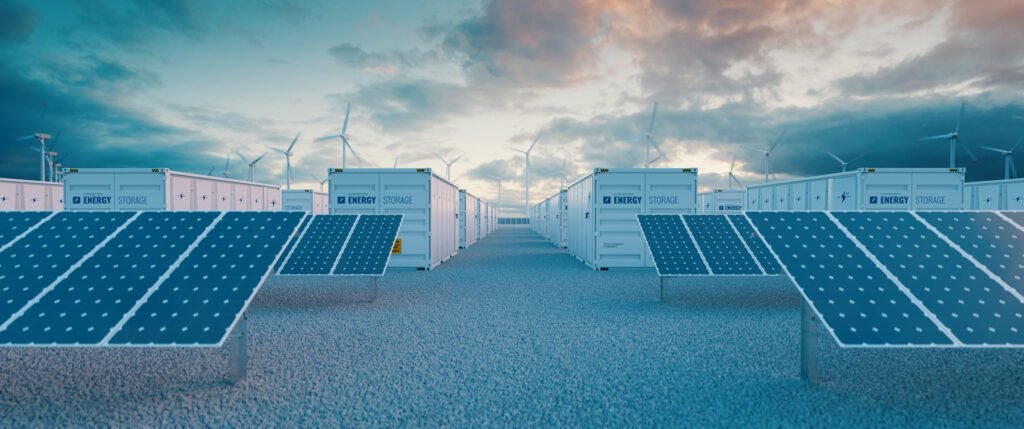
This is where design begins to matter. A private vehicle can shape an asset’s revenue profile in ways a listed holder simply inherits. Sell the output forward under a long-term offtake agreement, and variable merchant income becomes steadier, far less exposed to the swings of the spot market. Storage then adds a second lever of its own. Battery storage investment has become near-essential because holding power and releasing it on demand turns intermittent solar generation into something closer to firm, dispatchable supply, while capturing grid-balancing revenue that generation alone cannot reach. This is the logic behind pairing solar generation with storage in structures such as Solar45 and Baloico.
Neither contracts nor batteries remove risk. What they do is move the revenue line toward predictability, which narrows the range of plausible outcomes the investor carries. The volatility is engineered down at the asset level, not concealed by slow pricing.
What this means for portfolio construction
None of this makes one route better than the other in the abstract. Listed clean-energy equities give daily liquidity, full transparency, low cost, and the ability to size a position precisely and change it at will. Private infrastructure gives the opposite, insulation from market sentiment and the chance to hold contracted, firmed cashflows, paid for in liquidity given up, in immediacy lost, and in a horizon measured in years rather than seconds. An allocator is not choosing between volatile and safe. The choice is which kind of volatility to carry, and what to accept in return for being spared the other kind. It is the same question of behaviour over labels that runs through the case for defined returns.
The decision belongs to the portfolio, not the product. The same renewable exposure can be a source of daily mark-to-market noise or a quiet, illiquid compounding line, depending entirely on how it is held and where it sits in the wider book.
This is the ground Univere Investment Solutions works on. Univere introduces and distributes access to private market opportunities through regulated intermediaries, and the renewable theme has been part of that work for some time. The discipline lives in the design carried out by the third parties who structure these offerings: how revenue is contracted, how generation and storage fit, how suitability comes first. There is one completed example to point to. A Frankfurt-listed renewable energy bond paid investors 20% per annum and redeemed in full in December 2025, returning capital in full plus a further 60% across its three-year term. It is cited here only as a completed result, nothing more, evidence that the private route can be designed and built to deliver, and never as a forecast of what any future opportunity might or might not do.
The theme will keep drawing capital, and the argument over solar and renewables will run for years. The more practical question does not change. Settle whether the exposure belongs in the book, then settle how to hold it, because that second decision is where most of the volatility is won or lost.
Professional access only. Not for public or retail audiences. Univere Investment Solutions Limited is not authorised or regulated by the Financial Conduct Authority. This content does not constitute a financial promotion, financial advice, or an invitation or inducement to engage in investment activity.