Grid limits are reshaping how renewable projects are designed, and where private capital sits within them.
For most of the past decade, a solar farm and a battery were two separate decisions. One generated power. The other stored it, often somewhere else entirely, owned by a different party and wired into the grid at a different point. That separation is ending. Across the alternative investments market, renewable projects are increasingly designed as a single asset, with generation and storage sharing one site, one connection, and one set of commercial arrangements.
How an asset is built now decides what it can earn, long before any capital is committed.
The midday ceiling
Solar produces most of its power in the middle of the day, when offices are lit and factories run but household demand has not yet peaked. The mismatch matters. People draw the most power in the early evening, after the sun has dropped and the panels have gone quiet. By then the array gives little. When midday output runs past what the grid can take or what buyers want, the surplus has nowhere useful to go, so operators curtail it. Curtailment means ordering a working plant to make less than it can. It sits idle in full sun. In markets with heavy solar build-out, stretches of zero or negative power prices around noon have turned from an oddity into a routine.
Why are solar and storage now built on the same site?
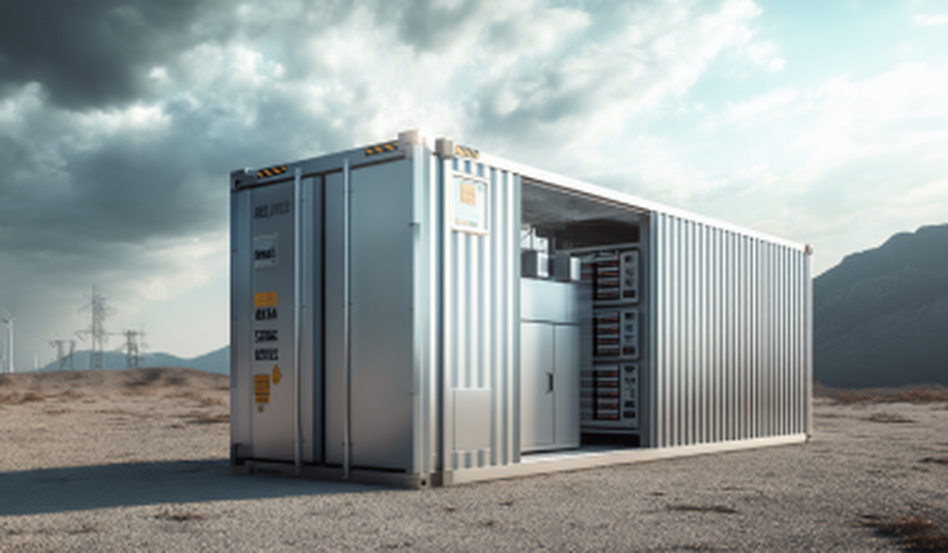
A battery fixes the problem solar creates. It absorbs the surplus generated around midday and releases it later, as evening demand lifts and prices rise. Sharing a site is what makes that pay. One grid connection and one footprint serve both functions, cutting out most of the cost and delay a standalone battery carries.
That second point matters. A new grid connection is one of the scarcest things in energy today. In several markets the queue to connect a fresh project runs for years, and the spare capacity at any given substation is finite, a constraint we examined in detail in the renewable energy cost of capital. A standalone battery joins that queue and competes for that capacity like anything else. Put the same battery at a solar connection that already exists or is already consented, and most of the wait falls away, because the access point is there. The project then uses a connection it already holds across far more of the day.
From two projects into one
Co-location changes the arithmetic of a renewable site. The same patch of land, the same access to the grid, and in many designs the same substation now do two jobs instead of one. Generation earns while the sun is up. Storage earns by moving that energy through time and by selling balancing services the grid needs, such as frequency response and short-notice capacity. Income arrives from more than one source, drawn off a single footprint and a single connection. The ground works harder for the same connection.
Engineering and commercial design are decided together. A financial case cannot be bolted onto a finished project and expected to hold. Where the battery sits, how it is sized against the panels, which services it is contracted to provide, all of that is settled in the design phase, well before an investor sees a number. The hybrid shape is becoming the default for new renewable projects for a plain reason. It earns more from the same ground. The scale of the shift is global: battery storage is now the fastest-growing power technology in the world, with 108 GW deployed in 2025 alone, according to the IEA’s Global Energy Review 2026.
What the shift means for alternative investments
For the private capital that funds these projects, the move from standalone to hybrid is not a question of engineering alone. It changes what is being assessed. A generation-only asset has a fairly readable income profile, tied to sunlight and a power-purchase agreement. A hybrid earns across several mechanisms at once, some contracted, some exposed to market prices, which is a harder thing to underwrite and a different risk to read. Diligence reads both layers, the generating side and the storage side, and how they depend on each other. What each of those revenue lines actually asks of the world is the subject of how allocators read yield across alternative investments.
This is where governance and design come before opportunity, not after it. The shape of the asset, its connection, its revenue mix, the contracts beneath it, all of this is fixed at origination. An investor who meets the project later inherits those decisions whole. Reading them properly, before any capital moves, is the work that divides a sound allocation from a hopeful one. The opportunity is downstream of the architecture, every time.
None of this is theoretical for Portugal, where solar build-out and grid limits have been visible for years. The market has form. The Santa Marta Bond, a Frankfurt-listed instrument that paid investors 20% per annum and redeemed in full in December 2025, came out of exactly this setting. It ran its term and returned what it set out to. The renewable projects taking shape there now, including those Univere introduces such as Solar45 and Baloico, are drawn for the grid as it actually behaves, with storage built in from the start rather than added once the limits bite. That design choice is the whole point. It is made first, and everything the project later earns is shaped by it.
Univere Investment Solutions works with professional readers who think about private capital in terms of access and architecture, not product noise. That is the lens. If it matches how you weigh an allocation, we would welcome a private conversation.
Professional access only. Not for public or retail audiences. Univere Investment Solutions Limited is not authorised or regulated by the Financial Conduct Authority. This content does not constitute a financial promotion, financial advice, or an invitation or inducement to engage in investment activity.